Hand creams are one of the easiest skincare products for beginners to formulate. Unlike facial products, hand creams focus primarily on moisturizing and protecting the skin from dryness caused by washing, weather, and daily activities.
A good hand cream should feel comfortable on the skin, absorb reasonably well, and provide long-lasting hydration without feeling excessively greasy.
Why Hand Cream Matters
Our hands are exposed to water, soap, detergents, sunlight, and environmental stress every day. These factors can weaken the skin barrier and lead to dryness, roughness, and irritation.
A well-formulated hand cream helps:
- Reduce moisture loss
- Improve skin softness
- Protect the skin barrier
- Provide a more comfortable skin feel
Basic Components of a Hand Cream
Most hand creams contain four essential groups of ingredients:
Water Phase
The water phase provides hydration and creates the lightweight portion of the formula.
Common examples include:
- Distilled water
- Aloe vera juice
- Green tea infusion
- Botanical extracts
Oil Phase
The oil phase provides nourishment and helps reduce moisture loss.
Popular choices include:
- Coconut oil
- Sweet almond oil
- Sunflower oil
- Shea butter
- Cocoa butter
Emulsifier
An emulsifier allows oil and water to remain mixed together.
Without an emulsifier, the cream will separate into layers.
Preservative
Because hand creams contain water, a preservative is essential for product safety and stability.
Always follow supplier recommendations when selecting and using preservatives.
Beginner Hand Cream Formula Example
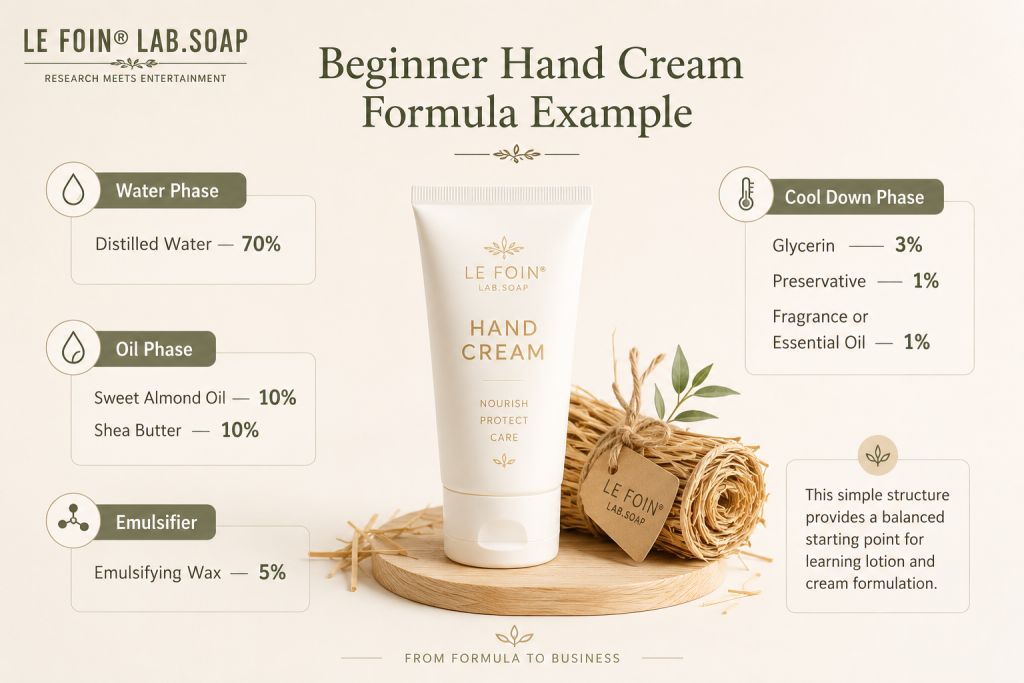
Water Phase
- Distilled Water — 70%
Oil Phase
- Sweet Almond Oil — 10%
- Shea Butter — 10%
Emulsifier
- Emulsifying Wax — 5%
Cool Down Phase
- Glycerin — 3%
- Preservative — 1%
- Fragrance or Essential Oil — 1%
This simple structure provides a balanced starting point for learning lotion and cream formulation.
Simple Manufacturing Process
- Prepare all ingredients.
- Heat the water phase and oil phase separately.
- Bring both phases to approximately the same temperature.
- Slowly combine the phases while mixing.
- Blend until a smooth emulsion forms.
- Allow the mixture to cool.
- Add preservative and fragrance.
- Package in clean containers.
Common Beginner Mistakes
Many new formulators make the following mistakes:
- Adding preservative at high temperatures
- Using too much fragrance
- Skipping preservation entirely
- Inaccurate weighing of ingredients
- Not maintaining proper sanitation
Careful measurement and good manufacturing practices are essential for consistent results.
Final Thoughts
Hand cream formulation is an excellent introduction to cosmetic science. By understanding water phases, oil phases, emulsifiers, and preservatives, beginners can begin creating products that are both enjoyable to use and professionally formulated.
With practice, simple formulas can evolve into unique products that support a handmade beauty business or personal skincare collection.
About LE FOIN® LAB.SOAP
At LE FOIN® LAB, we believe knowledge can become products, businesses, and opportunities.
Our mission is to make soap making, cosmetic formulation, and beauty entrepreneurship more accessible through research-driven educational content, practical guides, and digital resources.
From beginner tutorials to advanced formulation concepts, we help makers transform ideas into creations and creations into businesses.
Research Meets Entertainment.
About the Author